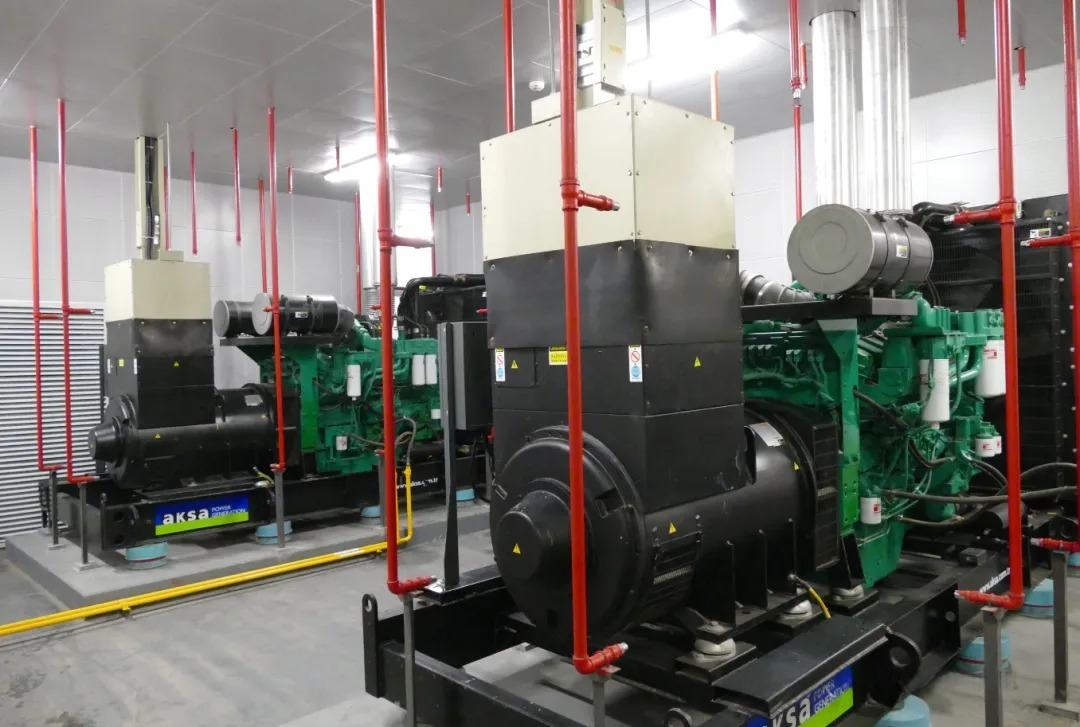
A diesel generator set has four power ratings, and using them incorrectly can lead to serious problems!This is a crucial issue. Inappropriate selection can result in insufficient power output from the generator set, affecting its use; or an oversized set, leading to waste.
As mentioned above, according to GB/T 2820.1-2022, “Reciprocating Internal Combustion Engine Driven AC Generator Sets Part 1: Applications, Ratings and Performance,” the main differences between the four power ratings (COP, PRP, LTP, ESP) of the same diesel generator set lie in operating time limits, load factors, and overload capacity, rather than simply differences in rated power values. For the same unit, its nominal power value usually follows the rule COP < PRP ≤ LTP ≈ ESP. Data from the national standard atlas “Common Data for Building Electrical Equipment” 19DX101-1 is worth referring to. As shown in the figure below, the standby power of a diesel generator set is about 10% higher than its operating power.
Parameter Description |
||||||||||||
| Prime Power of Generator Set (kW) | 120 | 250 | 400 | 500 | 600 | 800 | 1000 | 1200 | 1500 | 1800 | 2000 | 2200~2500 |
| Standby Power (kW) | 132 | 280 | 440 | 550 | 660 | 880 | 1200 | 1350 | 1650 | 2000 | 2200 | 2400~2800 |
| Exhaust Gas Volume (m³/min) | 30 | 54 | 80~100 | 100~110 | 140~180 | 180~200 | 200~250 | 250~300 | 300~400 | 350~450 | 450~500 | 500 |
| Exhaust Pipe Interface Quantity × Diameter (DN) | 1×80 | 1×125/1×150 | 1×150/2×125 | 1×200/2×125 | 2×150/2×200 | 2×150/2×200 | 2×200/2×250 | 2×200/2×250 | 2×200/2×250 | 2×200/2×250 | 2×200/2×250 | 2×150/2×250 |
| ——END—— | ||||||||||||
Below is a review of the definitions of the four power ratings and the corresponding operating limitations.
1.Continuous Power (COP): Applicable to constant loads, allowing unlimited operation at 100% load without any overload capability. This is the lowest power rating among the four, typically around 70%-80% of the base power.
2.Base Power (PRP): Applicable to variable loads, allowing unlimited operation at 100% load, but permitting 10% overload operation for 1 hour within each 24-hour cycle. Its value is higher than COP and is the most commonly used rated power rating for generator sets.
3.Limited-Time Operating Power (LTP): Applicable only to limited-time operation, allowing a maximum of 500 hours of operation per year at 100% load without overload. For the same generator set, the LTP rating is usually the same as or slightly higher than PRP, but the operating time is strictly limited.
4.Emergency Backup Power (ESP): Used only for emergency backup, operating at 100% load for a maximum of 200 hours per year (usually no more than 24 hours at a time), and overload is not permitted. The ESP rating is usually the same as or slightly higher than LTP, and represents the maximum power output of the same unit, but with the lowest availability.
In the above diagram (national standard drawing set), the “common power” might be the basic power, while the “standby power” refers to emergency standby power or time-limited operating power. Many diesel generator set manufacturers still label both common power and standby power.
Taking a diesel generator set with a common power of 2000kW in the drawing set as an example, its power rating data is as follows:
1.Basic Power (PRP): 2000kW, can operate indefinitely, allowed 10% overload up to 2200kW for 1 hour/day;
2.Continuous Power (COP): Approximately 1600kW, can operate indefinitely, overload strictly prohibited;
3.Time-Limited Operating Power (LTP): Approximately 2200kW, full-load annual operating time limited to 500 hours, overload prohibited;
4.Emergency Standby Power (ESP): Approximately 2200kW, full-load annual operating time limited to 200 hours, each operation not exceeding 24 hours, overload prohibited.
Just like a person needs to allocate their energy reasonably to finish a marathon, while a person needs to sprint with all their might to finish a 100-meter final!