
Have you ever wondered why some diesel generators can sit quietly at the entrance of a residential area or in a corner of a hospital, while others are as noisy as tractors, keeping the whole street awake? The answer lies in that “metal jacket.” Today, we’ll take a closer look at this magical device that silences generators—the soundproof enclosure (also called a noise-reducing enclosure)—and see what magic it uses to make this hundreds-of-kilowatt behemoth become docile and obedient.
1.Where does the noise from the generator come from?
To reduce noise, we must first understand its source.
When a diesel generator is running, there are three main sources of noise:
First, there’s the mechanical noise. The engine piston moves up and down dozens of times per second in the cylinder, the crankshaft spins wildly, and all sorts of gears mesh together—it’s no wonder it’s noisy.
Secondly, there’s the combustion noise. The shockwave from the explosion and combustion of diesel fuel in the cylinder is itself a huge source of noise.
Thirdly, there’s the exhaust noise. The high-temperature, high-pressure exhaust gas is ejected from the cylinder and expands instantly, making a sound like a firecracker.
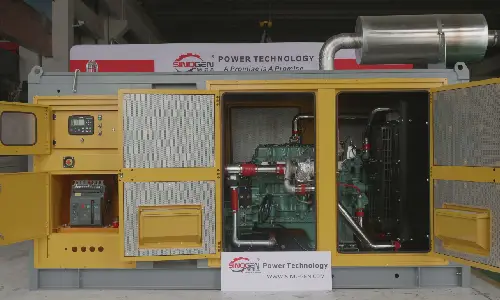
Therefore, to silence a generator, you need to address these three aspects. A soundproof enclosure is like putting a “soundproof robe” on the generator, trapping all the noise inside.
2. How does a silent box “seal” noise?
A good soundproof enclosure is like a well-designed house, where every part is carefully considered.
1. Outer shell: One Iron Shirt
The outermost layer of the soundproof enclosure is a metal shell, usually a 2-3 mm thick steel plate. This shell serves two purposes: first, it protects the internal unit from wind, rain, and human damage; second, it physically isolates most of the noise within the enclosure. You can think of it as an iron armor for the generator.
2. Sound-absorbing cotton: lining of down jackets
A metal shell alone isn’t enough; sound will bounce inside, creating echoes. Therefore, the inner wall of the metal shell is lined with a thick layer of sound-absorbing cotton. This cotton is usually a porous material, so sound reflects and rubs against itself inside, dissipating its energy. It’s like the down filling in a down jacket, trapping heat—except here it traps noise.
Patent documents show that some designs cover the entire inner sidewall of the enclosure with sound-absorbing cotton, leaving no place for noise to escape.
3. Air intake and exhaust ducts: a clever maze
This is the most particular place.
Generators require a lot of air to operate (for combustion and heat dissipation), so the enclosure must have air inlets and outlets. But if you make a hole in it, won’t the sound just escape?
The engineers came up with a brilliant idea: to turn the vents into a maze.
For example, noise-reducing baffles or louvered structures can be installed at the air inlets and outlets. These baffles are not straight but winding, allowing airflow to pass smoothly, but sound is repeatedly reflected and attenuated when it encounters the baffles, resulting in much quieter sound when it finally escapes.
Some designs are even more ingenious, placing the air intake on the top and bottom of the enclosure and minimizing side openings, thus trapping most of the noise inside the enclosure.
4. Silencer: Provides a buffer zone for exhaust gases.
As mentioned earlier, the exhaust noise sounds like firecrackers. Therefore, a muffler must be connected to the exhaust pipe.
The internal structure of this thing is also very ingenious. It is either a series of multiple chambers that allow the exhaust gas to expand, depressurize, and cool down inside, and finally be discharged quietly; or the exhaust gas is allowed to enter the silencer box through the air outlet on the silencer pipe to achieve a pressure drop effect and prevent the frightening sonic boom phenomenon.
5. Vibration damping device: Prevents vibrations from being transmitted.
The vibrations from a generator during operation are transmitted to the ground through the base and become noise. Therefore, the bottom of a soundproof enclosure usually has vibration damping designs, such as spring shock absorbers or rubber pads.
Some patents are cleverly designed, incorporating springs and sliders between the base and the casters, which facilitates movement and effectively reduces shock.
3. How to dissipate heat? This is a technical task.
At this point you might ask: Won’t the generator overheat if it’s covered up so tightly?
Good question! This is precisely the core challenge in designing a soundproof enclosure—it needs to both insulate against sound and dissipate heat.
Besides noise reduction, the air intake and exhaust ducts mentioned earlier also serve another important function: ventilation and heat dissipation. Engineers will install a blower or fan on one side of the enclosure to force in cool air, blow it over the generator surface, and then exhaust the hot air from the other side.
To prevent dust and debris from getting in, a dust filter must be installed at the air intake.
Some designs add heat sinks to the outer wall of the casing to increase the heat dissipation area. This is similar to the heatsink fins on a computer CPU, which quickly dissipate heat.
In short: a soundproof enclosure is a breathing soundproof shield.
4. The ultimate form of a soundproof box: taking convenience into account.
Modern soundproof enclosure designs go far beyond just noise reduction. Engineers have also considered many user-friendly details:
- Easy to move: Equipped with casters at the bottom, it can be pushed by one person.
- Easy to maintain: The cabinet has an inspection door with a handle, which can be opened to maintain the machine.
- Easy to hoist: Some designs change the protruding handle to an embedded groove, making the whole machine smaller and reducing transportation costs.
- Rain and dust protection: The louvered air inlet and outlet can also prevent rainwater from directly entering.
- Cable interface: Some designs use bottom entry, so that messy wires are not visible on the outside, resulting in a neat appearance.
A good soundproof enclosure allows you to speak normally from a meter away from the unit without being disturbed. This is achieved through the comprehensive application of various technologies such as sound insulation, sound absorption, noise reduction, and vibration damping.
The next time you see that backup generator working silently in your neighborhood, take a closer look at that sheet metal—it’s not just an ordinary shell, but a “silent armor” carefully designed by engineers.
After all, getting things to do their jobs quietly is a skill in itself.


